

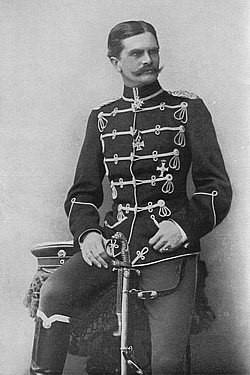
August von Mackensen in the First World War.
Introduction
General August von Mackensen, at the age of 65, served with remarkable effectiveness on the Eastern Front during the First World War, where his victories were of significant importance to the German Empire. At the war’s outbreak in 1914, he commanded the XVII Army Corps, which was eventually incorporated into the German Eighth Army under General Maximilian von Prittwitz—whose time in command was brief. The Eighth Army, known officially as Armeeoberkommando 8, was dissolved on September 29, 1915, and reconstituted on December 30 of the same year. Positioned in Eastern Prussia, it was tasked with defending German territory against the advancing Russian forces. While in charge of the XVII Corps, Mackensen succeeded in pushing the Russians out of East Prussia, most notably securing victory in the First Battle of the Masurian Lakes (2–16 September 1914), where the Russian forces under Paul von Rennenkampf were encircled and largely destroyed.
Later, in 1918, Mackensen was responsible for commanding the occupation troops in Romania. Following the Armistice in November 1918, he was captured by Hungarian revolutionaries and handed over to the Allies, remaining in custody until 1919. Renowned for his strategic competence and unwavering commitment to Prussian military tradition, Mackensen continued to be a respected figure, even after his active role in military operations ended.
1914
At the beginning of the war, Mackensen led the German XVII Corps and contributed significantly to early German successes. His troops were involved in the defeat of the Russian Second Army during the Battle of Tannenberg (26–30 August 1914), although he was not the overall commander of that engagement. Later, he played a decisive role in the First Battle of the Masurian Lakes (9–14 September 1914), during which the Russian First Army was forced to retreat from East Prussia.In the later months of 1914, Mackensen took part in the Battle of Łódź (11 November–6 December), where German forces attempted a large encirclement of Russian troops in Poland. Mackensen was recognised for his leadership and tactical acumen, and the engagement averted a Russian breakthrough even though the Russian forces were not destroyed. In addition to the Pour le Mérite, which was given in 1915 but was based on his 1914 exploits, he was awarded the 1st and 2nd Class Iron Crosses for his achievements during this year.
1915 – The Serbian Campaign
In October 1915, a major offensive against Serbia was launched under a newly formed Army Group Mackensen (Heeresgruppe Mackensen), composed of the German Eleventh Army, the Austro-Hungarian Third Army, and the Bulgarian First Army. Though the campaign did not result in the complete destruction of the Serbian Army, it forced approximately half of its forces to retreat through Albania to the Adriatic Sea, where they were evacuated and later redeployed to the Macedonian front by French and Italian forces.
Upon returning to Vienna, Mackensen was honoured with the Military Merit Cross 1st Class with Diamonds—a distinction rarely awarded to non-Austrians—and was personally received by Emperor Franz Joseph I at a private dinner.
1916 – The Romanian Campaign
When Romania declared war on Austria-Hungary on August 15, 1916, Mackensen was entrusted with leading a multinational Central Powers force composed of German, Austro-Hungarian, Bulgarian, and Ottoman units. The force assembled in northern Bulgaria and crossed into the Dobruja region by early September, capturing two key fortresses along the Danube’s southern bank. Mackensen’s forces established bridgeheads across the river and built pontoon bridges to support further movements.
Meanwhile, another Central Powers army under General Erich von Falkenhayn advanced through the Carpathians, entering Wallachia via the Vulkan Pass. This two-pronged strategy led to the fall of Bucharest, which was captured by the Central Powers on December 6, 1916. Mackensen entered the Romanian capital on his 67th birthday, riding a white horse, and set up his headquarters in the royal palace. In recognition of this success, he was awarded the Grand Cross of the Iron Cross on January 9, 1917—an honor granted to only a select few. A new class of German battle cruisers was also named after him. Mackensen proposed placing a German prince on the Romanian throne during his time as military governor of occupied Wallachia, but the idea was ultimately not realized. Despite his earlier successes, Mackensen encountered stiff resistance at the Battle of Mărășești (6 August–3 September 1917), where the reorganized Romanian Army, supported by Russian forces, managed to halt his advance and inflict considerable casualties. Romania found itself increasingly isolated after Russia’s withdrawal from the war following the Treaty of Brest-Litovsk in March 1918. Subsequently, Romania signed the Treaty of Bucharest on May 7, ceding southern Dobruja to Bulgaria and granting Austria-Hungary control over key mountain passes. However, King Ferdinand I refused to ratify the treaty, maintaining Romania’s legal sovereignty.
When the Central Powers began to collapse later that year, Mackensen’s campaign came to an end. Following the Armistice of November 11, German troops in Romania were ordered to withdraw, and Romania re-entered the war on the Allied side, invalidating the previous treaty.
End of World War I and Mackensen’s Death
Although sidelined by 1917, as control of the German war effort shifted to Generals Paul von Hindenburg and Erich Ludendorff, Mackensen remained an important military figure. His earlier campaigns in the Balkans and Eastern Europe had demonstrated both strategic skill and command effectiveness. In the final days of the war, Mackensen continued to lead German forces in Romania. On November 9, 1918, just two days before the Armistice, he was captured by Romanian forces.
Treated respectfully during his captivity, Mackensen was returned to Germany in late 1919. He retired from military service but remained a prominent public figure during the interwar period. A staunch monarchist, he frequently attended royalist and veterans’ events, often appearing in his iconic black Uhlan uniform.
After witnessing both World Wars, Mackensen passed away on November 8, 1945, at the age of 95—just months after the conclusion of the Second World War. His long life and military legacy made him one of the most enduring figures of Imperial Germany.
Written by: Konstantatos Panagiotis